Applications of 3D Printing in Formula 1
Discover how 3D printing is revolutionizing Formula 1 by enhancing design, reducing costs, and increasing team efficiency.
An hour on an FDM printer costs $0.12: depreciation, electricity and a failure reserve. The full calculation, and why hourly billing backfires.
Short answer: an hour on an entry-level FDM printer costs about $0.12 — roughly $0.08 in depreciation, $0.03 in electricity, plus a reserve for failed prints. That's the machine only: material and your own time come on top. On a $1,500 printer the same hour rises to about $0.44. Below is the full calculation — and why billing by the hour is usually the wrong way to quote.
Most people count only electricity and conclude the printer "barely uses anything". Electricity is the smallest line. The honest calculation has four parts:
| Line | How it's worked out | $330 printer |
|---|---|---|
| Depreciation | price ÷ lifetime in hours | $330 ÷ 4,000 h = $0.08/h |
| Electricity | power (kW) × price per kWh | 0.150 kW × $0.17 = $0.03/h |
| Subtotal | $0.11/h | |
| Failure reserve | 8% of subtotal | $0.01/h |
| Cost per hour | $0.12/h |
A printer doesn't last forever. Belts stretch, bearings develop play, the build plate loses adhesion, the extruder wears. Four thousand hours is a conservative lifetime for a well-maintained entry machine — roughly three years at four hours of printing a day.
Dividing the price by that lifetime gives how much each hour "consumes" of the machine. Ignore it and you find out late: the printer dies, and nothing was set aside to replace it.
An entry FDM draws around 150 W on average. Not the 350 W on the label: the heated bed cycles on and off, and once everything reaches temperature consumption drops a lot. At $0.17/kWh that's three cents an hour.
A 10-hour print uses about $0.30 of electricity.
Depreciation scales with price, so an expensive machine's hour costs far more — even on similar power draw.
| Machine | Price | Depreciation/h | Power/h | Cost per hour |
|---|---|---|---|---|
| Creality Ender 3 V3 | $330 | $0.08 | $0.03 | $0.12 |
| Bambu Lab A1 Mini | $410 | $0.10 | $0.03 | $0.14 |
| Creality K1C (enclosed) | $720 | $0.18 | $0.04 | $0.24 |
| Bambu Lab A1 + AMS | $870 | $0.22 | $0.03 | $0.27 |
| Bambu Lab P1S + AMS | $1,480 | $0.37 | $0.04 | $0.44 |
The $1,480 machine's hour costs almost four times the $330 one's. It only pays off if it prints far more, or makes parts the cheap one can't — ABS, multicolour, larger volume.
In resin printing one line appears that many only discover when the bill arrives: the LCD is a consumable.
A resin printer's screen lasts between 1,500 and 2,500 exposure hours and costs $55 to $110 to replace. That alone adds about $0.04 per hour — more than all the electricity.
Add the vat's FEP film ($8 to $22, replaced every 20 to 40 prints) and the isopropyl alcohol for washing, and the hour on a $390 resin printer lands near $0.18, against $0.13 if you counted only price and power.
This is the part that matters if you sell prints, and where almost everyone gets it wrong.
The machine hour is a cost, not a price. They're different things, and hourly quoting creates three problems:
What works is quoting per part: material + machine hours for the actual print time + your prep and finishing time, then the multiplier. The maker-market rule of thumb is total cost × 1.5 to 2.0.
The FDM cost calculator runs exactly this calculation with your numbers — your filament price, your electricity rate, your machine — and exports a PDF quote for the client. For resin, use the resin cost calculator.
There is one case where it fits: when you rent out capacity. Print-on-demand service, a bureau that receives the client's finished file, or a partnership where the other side supplies material. Then the machine is what you sell, and the hour is the natural unit.
The calculation becomes: cost per hour × multiplier. At $0.12 and a multiplier of 5 to 8 (covering idle time, support and the risk of a breakdown), you land between $0.60 and $0.95 an hour for simple FDM.
Want the full cost of a part, not just the hour? See How Much Does 3D Printing Cost. For how many parts come out of a spool, read How Much Can You Print With 1kg of Filament.
About $0.12 on an entry-level FDM: $0.08 depreciation ($330 over a 4,000-hour lifetime), $0.03 electricity (150 W at $0.17/kWh) and an 8% reserve for failed prints. On a $1,480 machine the same hour costs $0.44, because depreciation scales with price.
An entry FDM draws around 150 W on average — not the 350 W on the label, which is the peak. At $0.17/kWh that is three cents an hour, or about $0.30 for a 10-hour print. Electricity is the smallest part of the cost; depreciation is roughly three times larger.
Usually not. Hourly billing punishes efficiency (calibrating well cuts the time and your fee), ignores material (a hollow 20 g part and a solid 300 g one can take the same time) and leaves out your modelling and finishing work. Quote per part instead: material + machine hours + your time, times 1.5 to 2.0.
Because the LCD is a consumable: it lasts 1,500 to 2,500 exposure hours and costs $55 to $110 to replace, adding about $0.04 per hour — more than all the electricity. With the FEP film and washing alcohol, the hour on a $390 resin printer lands near $0.18.
Four thousand hours is a conservative estimate for a well-maintained entry machine — roughly three years at four hours of printing a day. Belts, bearings, the build plate and the extruder all wear. Using that figure for depreciation is what keeps money set aside to replace the machine.
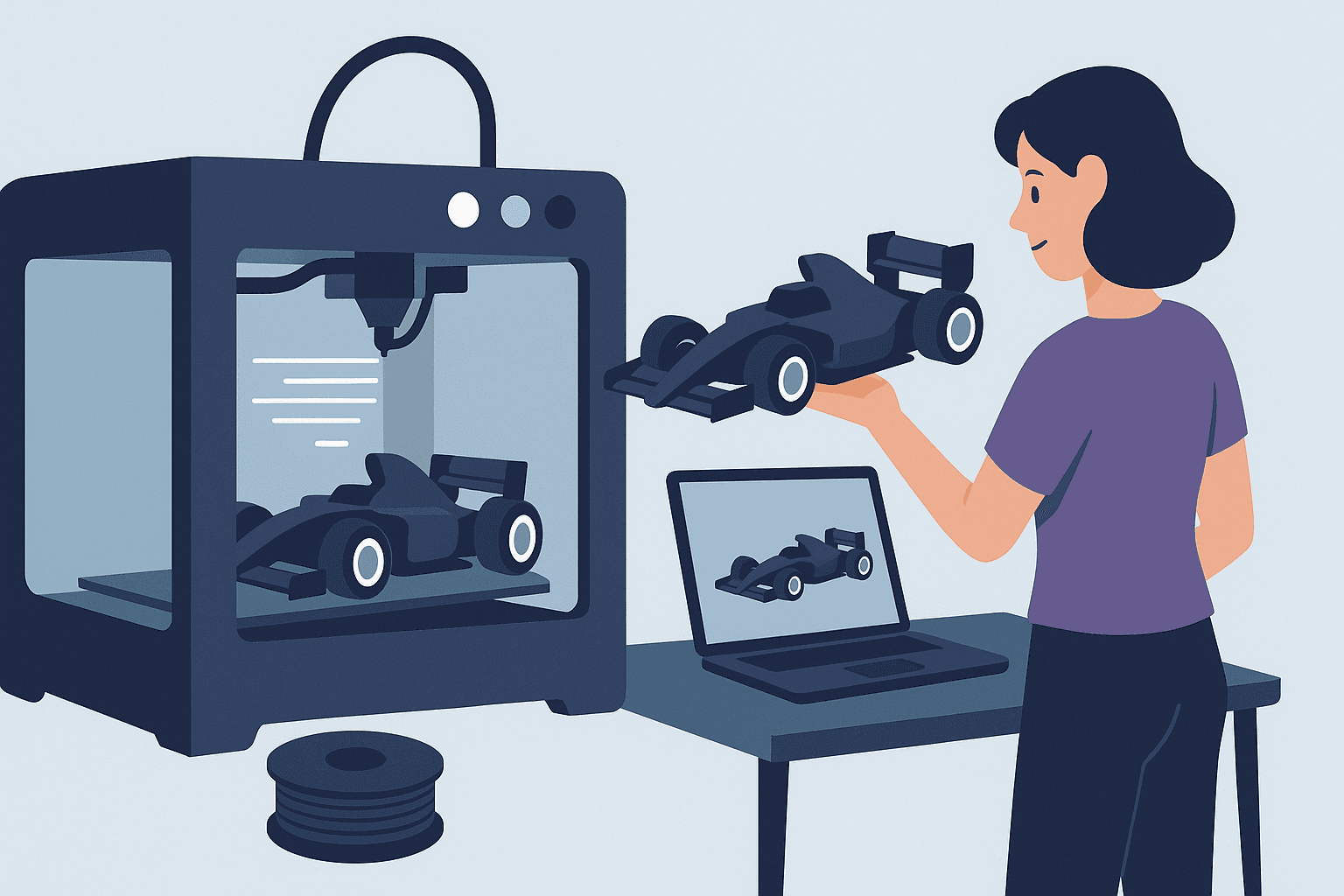
Discover how 3D printing is revolutionizing Formula 1 by enhancing design, reducing costs, and increasing team efficiency.
Discover how engineering and 3D printing are transforming design and production, offering innovative and customized solutions across various sectors.

Discover the key features of 3D printers and choose the ideal one for your project with our comparative table. Find out the differences now!